
AITA for Refusing to Pay for My Friend’s $50 Ribeye as a Vegan?
Even when one buddy offers to treat, going out to dine with friends is typically agreed upon by everyone. But it can easily turn into a cringe-inducing catastrophe when ideals clash and the soap won’t hold it. In this widely shared AITA article, a vegan man describes how he volunteered to cover the cost of dinner at a number of plant-based and vegetarian eateries. However, his companion fiercely objected and demanded that they go to a barbecue joint. The man agreed, eager to avoid another argument, but he refused to pay the asking amount for the meat. The companion laughed, but the retribution came with the bill.
The post has sparked a heated online discussion on whether it is ever acceptable to set boundaries, especially when it comes to personal beliefs, financial justice, and lifestyle ethics, or whether we can expect giving to be unconditional. Obviously, the companions are at a pub, where the social cost of eating meat is frequently displayed, and these are all issues of mutual respect in relationships, both real and imagined. They also raise the question of how much one should strive to accommodate someone else’s tastes after having already shown generosity.
You know what they say: never argue with someone over food unless you’re prepared to lose both your appetite and the friendship

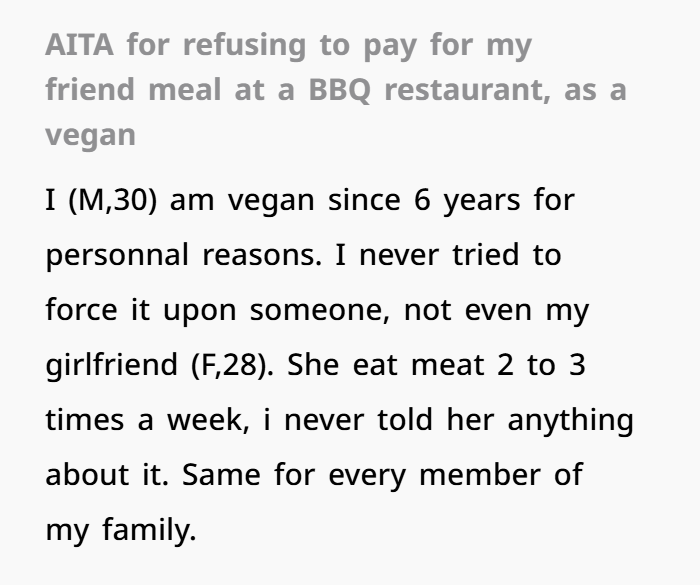
The vegan author offered to treat his friend to dinner at a plant-based restaurant, but the friend insisted on a BBQ place instead



A Dinner Invitation with Boundaries
Maritime The friend of Trash was attempting to be intrusive. It’s good that visitors want to show each other some love by offering to pay for a friend’s meal. However, it is accepted that the terms are reciprocal, courteous, and, well, reasonable, just like with other gestures. The poster, who has been a vegan for years, provided a comprehensive list of restaurants where he was ready to dine and spend his money. The cuisine at these eateries mirrored his personal lifestyle, morals, and financial situation.

That’s not controlling. That’s reasonable hosting.
However, the friend rejected all vegetarian and vegan options and insisted on a barbecue restaurant, where almost everything was meat-based. Preferences were no longer relevant here. It turned into a situation where someone was under pressure to cross moral lines and was then expected to pay the price.
The Financial Imbalance
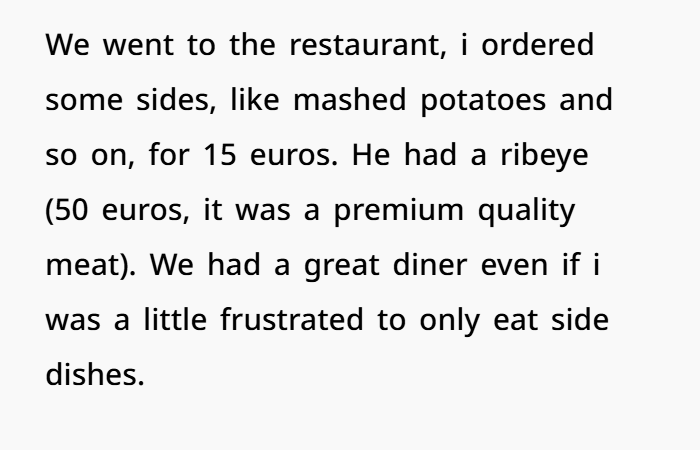
The friend paid €50 for a premium ribeye steak at the restaurant. The poster, on the other hand, managed to put together a feast consisting of only €15 worth of side dishes. There is a deeper imbalance here, even though some could see this as merely a difference in appetite or taste: the guest ordered more than three times the host’s lunch cost, even though it was made plain that his meat wouldn’t be reimbursed.
Being cheap isn’t the point here. It has to do with respect and justice. If someone offers to pay for a lunch and establishes a spending or menu expectation in advance, it should be respected, according to etiquette experts like Lizzie Post of the Emily Post Institute. It violates an unwritten social contract to go far beyond that, particularly when it involves something the host is morally against.
Ethical Eating Isn’t a Punchline
His companion thought it was a prank when the posting said he wouldn’t be paying for any meat. However, why is it amusing when a vegan sets boundaries?
This highlights a larger problem with the way veganism is frequently viewed in society—as a peculiar inclination rather than a respectable way of life founded on moral, environmental, or health considerations. Over 600,000 individuals in the UK alone identify as vegan, and millions more across the world switch to plant-based diets in an effort to lessen their influence on the environment, lessen animal suffering, or manage long-term health conditions, according to a 2023 report by The Vegan Society.

It’s not just rude to ask a vegan to buy beef. It is disrespectful. It’s like asking a recovering alcoholic to pay your bar tab or asking a Muslim to buy pork for someone.
Anything you want to eat is fine. However, respect should be reciprocated if someone else is paying, particularly if they have shared their principles.
Was the Poster Obligated to Pay?
To be clear, the poster did not change its mind. He made it quite clear that he would not be paying for the friend’s supper if they went to the BBQ business. The companion verbally agreed to those terms. The agreement is not nullified by laughing it off. Just because someone didn’t take a limit seriously doesn’t mean the host has to explain it over.
The friend became angry when the bill came and he realised he was actually in charge of the €50 ribeye. However, this was the inevitable result of disregarding someone’s explicitly stated boundaries; it wasn’t treachery.
Even going to a restaurant that probably made him uncomfortable was a compromise, if anything. He refrained from lecturing, embarrassing, or interfering with the friend’s decision to consume meat. All he did was draw a line around what he would not fund.
And that is absolutely within his rights.
Reddit Weighs In: Not the A**hole
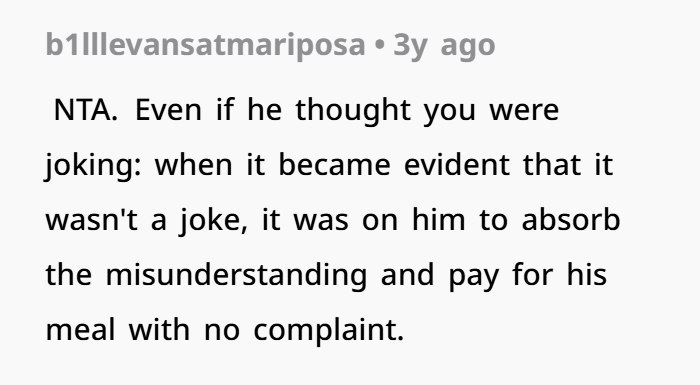
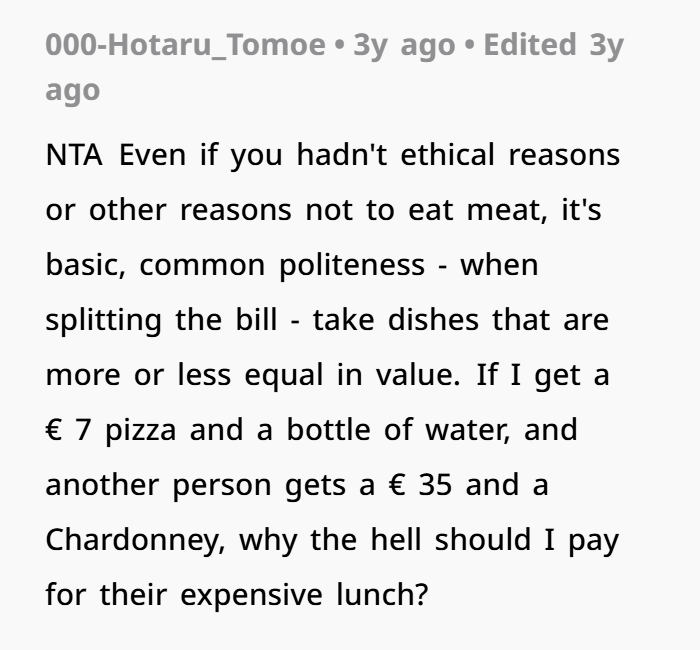
The verdict is unmistakable on places such as Reddit’s r/AmItheAsshole: Not the A-hole. The poster’s patience, lucidity, and the fact that he still made the effort to spend time with a friend who refused to compromise are being praised by top commenters.
One commenter writes:
“You went above and beyond by offering to pay in the first place. The moment he insisted on steak and laughed at your boundary, he disrespected you. Actions have consequences.”
Another adds:
“If he couldn’t handle the cost of his steak, he shouldn’t have ordered it. You warned him. You weren’t petty—you were principled.”
This sentiment reflects a broader cultural shift where people are increasingly being encouraged to protect their values and stop being guilt-tripped into people-pleasing.
The Real Issue: Entitlement vs. Friendship
In the end, veganism and barbecue weren’t the true points of contention. It was about friendship masquerading as entitlement. Despite their repeated cautions and ethical objections, the friend wanted someone else to pay for the meat, not only to consume it. That isn’t what friendship is. Selfishness is what that is.
Mutual respect should be the foundation of friendship, particularly when one person is giving. You don’t swat the offering hand away and then complain that your steak knife wasn’t held in it.
After the dinner, the author and his friend didn’t speak, and the friend was entitled, anyway


Was this story’s vegan the jerk for not wanting to buy a $50 steak? Not at all. He addressed everything up front, made concessions to keep the friendship together, and offered supper with clear boundaries. His friend decided to disregard that, and he is now upset about the results of his own choice.
Stories like this wouldn’t even be needed if more people took financial justice seriously and respected one another’s ideals. Till then? The issue isn’t this guy. Simply put, he isn’t paying for one.


