Mom Shocked When Partner Complains After Kid Asks for a Ride to Say Goodbye to Dying Dad
A grieving mother turned to the internet after her long-term partner refused — then reluctantly agreed — to drive her 16-year-old daughter to the hospital to say a final goodbye to her dying father. What should have been a sacred, compassionate moment turned into a traumatic memory, as the partner berated both mother and daughter during the drive and coldly refused to offer a return lift. While the daughter was overwhelmed with grief, the man complained about being treated like a “taxi driver” and being “dictated to by a little girl.”
The post has sparked intense emotional debate across forums, striking a nerve for those who’ve navigated blended families, end-of-life grief, and emotional abandonment in moments of crisis. At its core, it asks a chilling question: When someone shows you who they really are in your darkest hour, can you ever see them the same way again?
They say you truly get to know someone not in moments of calm, but in the difficult situations that tests your limits

The author’s ex-husband, father to her two children, passed away just six weeks after a sudden diagnosis




The things this post talks about are terrible, not just because a child lost her father, but also because her mother’s partner of seven years, who she should have been able to depend on at that time, decided to make it about himself.
In simple terms, the 16-year-old daughter had very little time to say goodbye to her dying father. It wasn’t a last-minute request made because someone was lazy or didn’t plan ahead. It was a real-time, heartbreaking emergency, and the daughter showed how upset she was by crying and pleading. There was her mother there. Big brother was already with their dad. What is the only piece missing? A lift.
The mother said that her partner, who is the only adult who drives, was already “in a mood.” He didn’t say “Of course, let’s go” when he was told that his daughter needed to be rushed to the hospital. Instead, he said:

“She shouldn’t be there when he dies; it will hurt her.”
Even worse: “A little girl shouldn’t be telling me what to do.”
It’s not just rude to do this. It’s rude, cold, and doesn’t care about how you feel. It breaks my heart that this wasn’t about logistics, but about who had power. The partner didn’t disagree because he thought something was really bad; he just didn’t want to be told what to do, even when there was an emergency. That way of thinking is troubling for anyone who is close to a family that is suffering.
The Power of Saying Goodbye for Good
Most psychologists agree that for kids and teens, saying goodbye to a loved one who is dying can be one of the most important parts of grieving. Child Bereavement UK says that young people who are able to say goodbye and understand what is going on are often better able to deal with their feelings after a loss. Stopping people from saying goodbye for good or making it seem like a scary or unsuitable event can do more harm than good.
The daughter knew what she wanted, and that was to see her father, even though he was dying. If you don’t give it to her or make her feel bad for asking, it adds a second layer of stress that will last for years.
And telling her she’s “dictating” something while she’s crying over a loss is not only rude, it’s also hurtful to her feelings.
When Compassion Fails: The Real Colours of a Partner
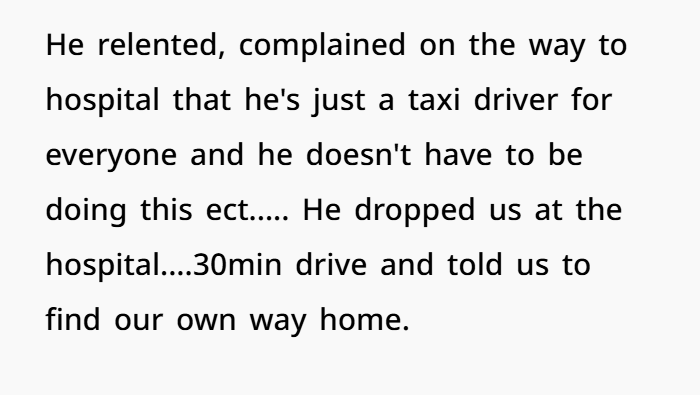
The most upsetting thing about this story might be how the partner acted after giving in. Even though he agreed to drive them, he complained the whole way, saying he was “just a taxi driver” and “shouldn’t have to be doing this.”
He made this child feel like she was an inconvenience at the most important time in her life emotionally.
The worst part was that he just left them there, unwilling to pick them up or help them in any other way.
It’s not just about the lift, let’s be clear. This is about how a man who has been with this family for seven years doesn’t care about them. This person is connected to them, even though he doesn’t live with them. He is connected to the mother and probably also to the children. But when they needed him the most, he decided to emotionally leave them and focus on himself.
“He ought to have held it together for one more day.”
A very important and painfully basic question is asked on the poster:
“Is it too much for me to believe that he should have just been quiet for one more day?”
A lot of people who commented and anyone who is mentally healthy said the same thing: no, you are not unreasonable. It hurts you. You want to keep your child safe. And when it counts, you see this person for what they really are.

In a disaster, you have to show empathy. You don’t take turns getting it. When people you care about are going through mental pain, especially kids, the very least you can do is be there for them in silence. But not criticism. Not a sneer. Doesn’t shame.
It’s not just a slip-up to fail at that point. It shows a lot about your character.
What Will Happen Next?
The OP says she’s so mad that she can’t even talk to her partner right now. And for good reason. It’s not just upsetting what her partner did. It hurts my feelings of safety.
The huge reaction on Mumsnet (639 replies so far) backs up her anger. Many people who commented said that this could be the end of the relationship, not because of one event, but because of what that event stands for. Some people told her to think about how the daughter felt on the drive and what message she might have gotten about her loss and worth.
Some people brought up the subtle emotional manipulation that was going on, where the partner made himself the victim of someone else’s disaster. That’s a red flag for being self-centred in a relationship, and it often means that an issue with understanding or control is at play.